
6 Quick Reference Guides on Early Social Skills & Behavior
December 11, 2025
Need to get your program staff up to speed with developmentally appropriate practice in the new year? Kathy Reschke’s Quick Reference Guides for Early Childhood Best Practices are a great addition to your professional learning toolbox. These laminated guides are practical, durable, and full of lists, tips, and colorful illustrations that make best practices easy to learn and remember.
Read Kathy Reschke’s article:
A-Ha Moments & More: 5 Reasons Why Every Early Educator Needs These New Guides
Today we’re spotlighting the Quick Reference Guides that cover the development of essential social and behavioral skills in young children. If your program staff need a refresher on any of these topics, or if you’re welcoming new staff who need a quick reference on the fundamentals, these six cost-effective guides are perfect for you.
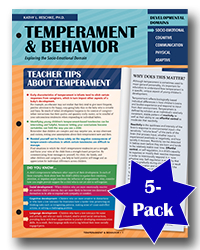 Temperament & Behavior
Get practical guidance on how temperament affects early development—and how teachers should consider temperament when caring for and teaching children. Covers myths and facts about shyness, expressions of temperament and how they develop over time, ways to provide a “good fit” for the wide range of temperaments in a classroom, and more.
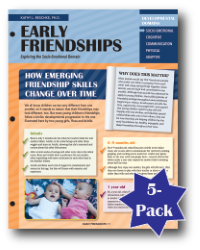 Early Friendships
Help young children develop the early foundations for healthy, enjoyable friendships. Covers the component skills children need for building friendships, how emerging friendship skills change over time, ways to nurture friendships and support children who may need help developing connections, and more.
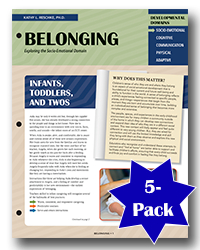 Belonging
Proactively foster a sense of belonging for every child in a classroom! Covers specific developmental characteristics to focus on, implementation of strategies that intentionally build community in the classroom, ways to use the shared classroom environment to promote belonging, and how to conduct self-reflections to strengthen teaching practices.
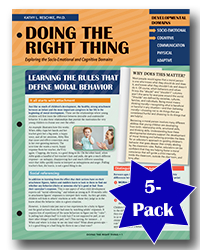 Doing the Right Thing
Get practical guidance on how to help foster a moral conscience that will guide a child internally, inside and outside the classroom. Covers how children learn the rules that define moral behavior, how to encourage moral behaviors such as sharing and taking turns, what to do when children make the wrong choice, and more.
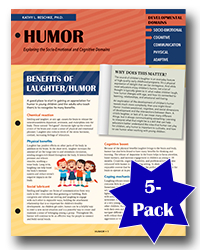 Humor
Humor
Learn how to leverage the benefits of humor in an early childhood classroom! Covers the physical, social, and cognitive benefits of smiling and laughter; how children’s humor changes and becomes more complex over time; ways to help ensure that surprising experiences are funny to children and not distressing; and more.
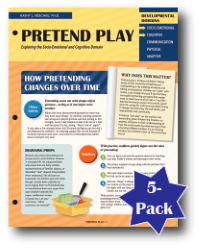 Pretend Play
Discover how and why to focus on enhancing and supporting children’s pretend play skills. Covers why pretend play matters, how pretend play can promote socio-emotional and cognitive development, how to nurture children’s skills as they role-play and interact with peers, and when to be concerned about children’s pretend play (and what to do next).
Start off a great year with these guides—the easiest way to put essential knowledge and ready-to-use strategies in the hands of every educator in your program.
Three ways to order your guides:
- Mix and match: Order individual copies of the guides for just $12.95 each.
- Get 5-packs: Ensure all staff members can have their own copy. (Each pack: $59.95)
- Get the set of 16: Make a complete professional development package for $184.95.
More posts like this

A-Ha Moments & More: 5 Reasons Why Every Early Educator Needs These New Guides
February 13, 2025
10 Ways to Record Early Childhood Observation Data
November 20, 2025
Write a Comment
Your email address will not be published. Required fields are marked *
Post a Comment