
Try This Redirection Strategy for Student Behavior Challenges
January 22, 2026
 Distracting or disruptive student behavior is something nearly every teacher struggles with on a daily basis. If you’re using trauma-informed preventive approaches to classroom behavior, that’s a great foundation—but there will always be some students who will benefit from intervention strategies like redirection.
Adapted from The Teacher’s Guide for Effective Classroom Management, here’s some helpful guidance on when and how to use redirection techniques with your students.
Distinguish Between a Nuisance and a Problem
First, it’s important to differentiate between nuisance-level behavior and problem-level behavior in a classroom. Each warrants a different type of response.
Nuisance-level behaviors are the things kids do that (although bothersome) are inconsequential. This type of behavior is best addressed through indirect intervention: ignore the student’s nuisance behavior while using reinforcement to promote desired behavior. There are two types of situations in which you may need to systematically ignore nuisance behavior:
- One-to-one situation. You could simply not respond to the nuisance behavior as if you did not see it. This is often referred to as planned ignoring. Rather, focus on things the child is doing correctly and avoid providing visible attention toward fidgeting or brief moments of off-task behavior.
- Group instructional situation. When a child engages in nuisance-level behavior in a group, find other students who are engaged in desired behaviors and reinforce those students one at a time for appropriate behavior (while not responding to the other child’s nuisance behavior). Next, capitalize on the opportunity to “catch the child being good” by explicitly reinforcing them for appropriate behavior once they cease the nuisance behavior.
Important note: Apply a compassionate eye when identifying nuisance-level behavior! Some behavior is simply not within the student’s ability to fully self-regulate (such as motor tics associated with Tourette syndrome).
Problem-level behaviors are those that are truly disruptive or potentially harmful. Examples include 1) a student being off task for a time that is longer than reasonable despite your efforts to intervene indirectly, 2) behavior that pulls other kids off task or creates a physically or emotionally unsafe situation, and 3) behavior that places a student or others in harm’s way. Problem-level behavior will require redirection.
Use This Three-Step Redirection Technique
When consequential problem-level behavior occurs, intervene directly by employing a basic three-step redirection process:
Tell the student to stop the problem behavior.
For example: When Cheyenne engages in problem behavior, directly intervene by getting in reasonable physical proximity—not too close but not too far away—and assertively stopping her from continuing the problem-level behavior. Be specific and label the behavior you want her to stop (e.g., “Cheyenne, stop grabbing Kai’s materials off his desk”).
Direct the student to perform a more desired behavior.
Once you have gained Cheyenne’s attention with your “stop” statement, redirect her to an alternative behavior that is in keeping with your established expectations. Be sure to state the alternative behavior clearly: for example, “Take a deep breath, let go of Kai’s book, and keep your hands on your own materials and start doing your work.” Provide corrective feedback (when needed) in as private a manner as possible to minimize the likelihood of public power struggles or embarrassment.
Reinforce the student once they comply with your redirection.
Once you have redirected Cheyenne, pause and wait for her to respond. If she does not comply, simply repeat your verbal redirection, adding additional prompts and cues if needed to enable compliance. When compliance occurs, provide reinforcement for following your redirection. Provide explicit verbal praise for compliance (e.g., “Thank you, Cheyenne, for using your own materials and doing your work”).
Remember: you are not reinforcing the student for the problem behavior, you are reinforcing them for compliance with your redirection when they perform the alternative appropriate behavior. Be sure to be explicit about what you are reinforcing by providing behavior-specific praise.
4 More Tips to Remember
- Practice indirect and direct intervention techniques so they become habitual within the ebb and flow of daily activities. The key is practice—ideally through simulated activities with your colleagues—followed by consistent application and professional reflection. You might lean into the effective practice of video self-reflection to witness and reflect on your personal growth.
- Keep in mind that behavior is not random; it serves a purpose for the student. Don’t limit your perspective on a student’s undesired behavior to what it looks like or sounds like.
- Be observant for patterns that may emerge with particular students. Depending on your level of concern, it may be helpful to record the frequency, intensity, and duration of a student’s behaviors of concern.
- Remember that redirection procedures are short-term solutions. By design, their intent is to “put out the fire” at that moment in time. When patterns of concerning behavior emerge, a student’s needs may require more investment in a trauma-informed preventive procedures and Tier 2 (targeted) strategies. See The Teacher’s Guide for Effective Classroom Management for a whole chapter on Tier 2 strategies for behavior support.
To learn more about preventive and interventive strategies for classroom behavior management, see the book behind today’s blog post!
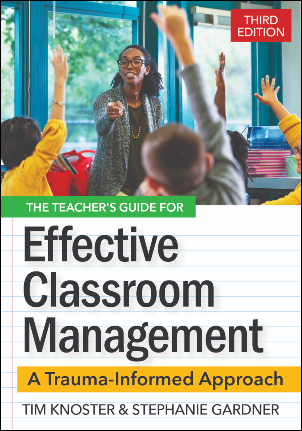
The Teacher's Guide for Effective Classroom Management
A Trauma-Informed Approach, Third Edition
By Tim Knoster, Ed.D., & Stephanie Gardner, Ph.D.
Apply a trauma-informed lens to K–12 classroom management with the third edition of this bestselling book. Developed by experts on trauma-informed and positive behavior support, this new edition offers practical guidance for creating a safe, supportive, and smoothly functioning classroom environment for all learners.
More posts like this

21 Trauma-Sensitive Teaching Tips to Try This School Year
August 1, 2024
7 Steps to Establishing Classroom Behavior Expectations
July 22, 2025
Write a Comment
Your email address will not be published. Required fields are marked *
Post a Comment