
4 Ways to Improve Attachment Security in Children with Disabilities or Delays
February 5, 2026
Are you an early childhood, education, or healthcare professional working with children experiencing disability, developmental delay, or developmental risks? This blog post is for you!
 Dr. Stacey Alexander, Senior Manager of Services at Noah’s Ark Australia and author of the new book Attachment-Focused Early Childhood Intervention, is here to talk about the challenges of secure attachment for children with developmental concerns—and what you can do to help.
Read on for Dr. Alexander’s insights!
***
I’m a psychologist with a background in early childhood intervention, child protection, disability, and family therapy. Some years ago, I became very curious about the role of attachment security in the life trajectories of children accessing early childhood intervention or disability services. I began to explore the research—and the more I explored, the more curious I became.
I discovered that forming a secure attachment could be challenging for children with developmental concerns, and that there are many flow-on effects of that. Spurred on, I did a Ph.D. study on how early childhood intervention professionals could improve the attachment security of children with a disability or developmental delay. My study included a survey of professionals, in-depth interviews with parents and professionals, and a systematic review of attachment patterns and interventions for children with a disability or delay.
I found compelling reasons for why professionals should take an attachment focus in their work.
Why Focus on Attachment Security?
Let’s start with four reasons why attachment security is worth your attention:
- Boost overall development: Attachment security is positively associated with prosocial behavior, communication, executive function, learning, physical and mental health, self-regulation, and social skills. Attachment security is a variable you can impact to enhance overall learning and development.
- Reduce risk: Conversely, insecure and disorganized attachment is associated with an increased risk of emotional, behavioral, and mental health problems, maltreatment, and neglect. Children with a disability have a heightened risk of maltreatment, and/or a diagnosis of a behavioral or mental health condition. Your attachment-focused actions can reduce these risks.
- High rates of insecure and disorganised attachment: Children with a disability or developmental delay are significantly more likely to develop insecure attachment relationships than children in the general population and are almost twice as likely to develop a disorganized attachment. Your intervention can positively influence attachment formation.
- If not you, now, then who, when? If you are working closely with children and their parents or caregivers, then you have an amazing (and vital) opportunity to make a positive impact on their outcomes through supporting the development of secure relationships. The earlier this is done, the better. I say seize the opportunity while change is easily supported. Don’t wait until problems become entrenched, requiring more intensive, specialist responses.
How Can You Help?
Okay, so there are plenty of reasons to take an attachment-focused approach in your work, but how do you do it? Regardless of your level of experience or your professional background, there are many ways you can help.
One of the most exciting things I found in my research is that there are probably a lot of things you are already doing that are helpful. You might just be doing them for other reasons. Perhaps unsurprisingly, the quality of the relationship you have with the family is the most important factor in how successful you are likely to be in this endeavor to support the parent-child relationship. The family-professional relationship can be supported by best practice approaches, including a key worker or lead practitioner model, strengths-based practice, coaching, and working within the child and family’s regular routines and environments.
Now, within the context of high-quality family-professional relationships and a best practice approach, here are my top four ways to improve attachment security in children with disabilities or delays:
Support parent-child communication.
 Whether you are working with a child on speech and language goals or on any other aspect of their development, well-being or participation, communication is at the core. It also doesn’t matter if the child is able to communicate through speech—they will be communicating through their behavior, eye gaze, body language, and sounds. The more we can support parents to understand the importance of communication with their child, boost frequency and positivity, and support timing and mutual comprehension, the more we can support the building of secure parent-child relationships.
Reduce parental stress.
 Parental stress significantly challenges the formation of secure parent-child relationships. Parents may experience stress from socioeconomic factors, work pressures, relationships with others, competing demands on their time, and the experience of parenting itself. Parents of children with disability or developmental delay can face additional strains in accessing information, advice, and resources, and adjusting emotionally to their child’s diagnosis or additional needs. Statistics also tell us that families of children with a disability are more likely to be experiencing other contextual risks, such as poverty, mental or physical health problems, and family violence.
Keep a keen eye on parental stress in all that you do. Think about how you can help parents build their skills in identifying and addressing their stressors. Help them build their informal and formal support networks. Make referrals to family support services or counseling. Help parents understand the importance of looking after themselves so they can support their child. Finally, carefully consider the possibility that you may be inadvertently contributing to their stress and think about how you might be able to rectify that.
Talk about attachment.
 One of the things I discovered in my research was how few professionals in early childhood intervention had learned about attachment at university. This made me think that very few parents in the general community would know much at all about attachment. You can make a difference by chatting with parents about:
- What attachment is
- The importance of attachment in their child’s development and well-being
- How to recognize their own child’s attachment behaviors
- How to support their child to feel secure
Support co-regulation.
 The connection between the development of parent-child attachment is entwined with the process of co-regulation. Co-regulation is how infants and young children develop their ability to self-regulate. Self-regulation is a key factor in behavior and social interactions, thus playing a powerful role in overall development, well-being, and participation. Beginning with physically rocking and cooing a distressed infant to soothe them, co-regulation can become more complex as the child develops.
If a parent is stressed and/or was not well supported in co-regulation when they were an infant or child, you can support them to:
- Identify their own feelings, and those of their child
- Develop strategies to support a parent’s own regulation, such as mindfulness exercises or other calming techniques
- Co-regulate their child from a place of calm
An attachment-focused approach can make a positive and lasting impact on child and family outcomes. I hope this blog post has piqued your interest about supporting development of secure parent-child attachment relationships in the children you are working with. If you are currently working closely with children and families experiencing disability, developmental delay, or developmental risks, you have a pivotal opportunity. Embrace it!
***
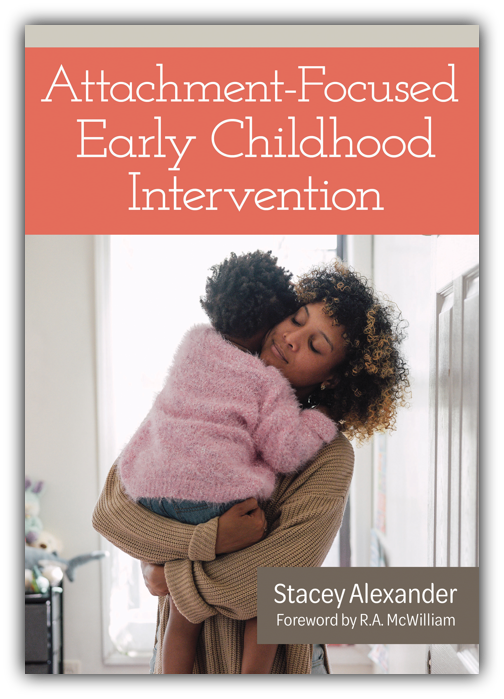
Attachment-Focused Early Childhood Intervention
By Stacey Alexander, Ph.D.
This groundbreaking book is your complete guide to the why and how of helping families improve the attachment security of children with disabilities. Written in an engaging, conversational style and firmly rooted in EI best practice, this accessible resource delivers evidence-informed strategies for enhancing parent–child relationships in the critical early years.
More posts like this
9 Ways to Strengthen Family Partnerships
September 25, 2025
9 Ways Home Visitors Can Support Infant Mental Health
October 8, 2024
Write a Comment
Your email address will not be published. Required fields are marked *
Post a Comment