
Why Use ASQ:SE-2? 8 Questions Answered!
July 9, 2026
If you haven’t started using ASQ®:SE-2 for social-emotional screening, take a minute to read about what it can do for your program and the young children you work with. ASQ:SE-2 isn’t just an add-on to ASQ®—it’s an important part of comprehensive early childhood screening that helps get kids off to the best possible start.
Read on to find out why!
(Already use and love ASQ:SE-2? Share this article with a program leader who might need convincing!)
Why is it important to screen specifically for social-emotional development?
Children’s ability to regulate their emotions and skillfully manage social interactions is critical to their healthy development and future success. Beginning at birth, babies use vocalizations and body movements to begin building relationships. These relationships help young children feel a sense of comfort, safety, and confidence—all necessary for forming friendships, communicating emotions, and dealing with challenges.
Ensuring that every child has strong social-emotional skills through screening, early identification, and competence-building exercises helps prepare them for school, reduce bullying, and improve their well-being. And all of this helps set children up for future success!
Why should our program use ASQ-3 and ASQ:SE-2 together?
Many social-emotional challenges go unrecognized prior to kindergarten, keeping kids from receiving the interventions they need during those critical early years. Using ASQ:SE-2 alongside ASQ-3 provides a much more comprehensive look at a child’s development.
While ASQ-3 does touch on social-emotional skills, ASQ:SE-2 goes much further, delving into the child’s skills and progress in seven key areas to offer broad and deep knowledge of this important area of development. Because behavior and development are linked, using the two tools together can also add important context to responses and scores from either questionnaire.

CASE STUDY:
See how the Baltimore Infants and Toddlers Program uses ASQ and ASQ:SE-2 together.
How would ASQ:SE-2 fit into our current screening process?
ASQ:SE-2 is very similar to ASQ-3, so it’s easy to use them together. The ASQ developers offer these implementation tips for different program types:
- Home visiting programs: Leave both ASQ-3 and ASQ:SE-2 questionnaires with parents 2 weeks prior to a scheduled home visit. Or you can administer one tool during one visit, then the other tool during a subsequent visit. Traditionally ASQ-3 is used first since it covers the majority of domains, but there’s no reason ASQ:SE-2 can’t be given first if desired.
- Center-based programs: Ask parents to complete both tools independently at home. Alternatively, ASQ-3 can be completed during a scheduled event like parent education night, with ASQ:SE-2 to follow while children play or at home. Screening can also coincide with parent–teacher conferences. ASQ-3 can be administered during the conference and ASQ:SE-2 can be independently completed at home either before or after the conference.
- Clinical setting: Parents can come to an appointment 30 minutes early to complete both questionnaires, or they can complete them at home and bring completed questionnaires to their next well-child visit.
As with ASQ-3, ASQ:SE-2 screening data can be managed effectively within our time-saving ASQ Online system.

Still using paper?
Watch a demo to see what the ASQ Online system can do for your program.
Should ASQ:SE-2 be used with every child?
Yes, the ASQ developers recommend every child be screened with ASQ:SE-2 as a measure of behavior and social-emotional skills. Social-emotional skills are critical for school readiness, and identifying delays early can reduce the likelihood of later serious behavior or mental health problems.
Some programs may experience budgetary constraints that prevent them from screening all children with ASQ:SE-2. These programs may choose to screen only children that score below the cutoff on the Personal-Social and/or Communication domains of ASQ-3. In this scenario, the developers also recommend administering ASQ:SE-2 if a parent expresses concerns related to the child’s social-emotional development.
What if a child has a disability? Should we still use ASQ:SE-2 with that child?
If a child has a diagnosed cognitive or physical disability, the developers recommend using ASQ:SE-2 in a slightly different way. Your program can use ASQ:SE-2 to provide a profile of the child’s strengths and problem behaviors for parents and caregivers, but because children with disabilities often score above the cutoff, the score should not be compared to normative cutoff scores.
Can ASQ:SE-2 screen for autism?
While ASQ:SE-2 is not an autism screener, the questionnaires contain items designed to detect behavioral and communication concerns that may point to autism. Results from ASQ:SE-2 may assist programs in making decisions about referrals for autism testing.
Ongoing research is being conducted, but preliminary analyses suggest that ASQ:SE-2 should identify the majority of children on the autism spectrum. The classification of children on ASQ:SE-2 was compared for 133 children between 18 and 60 months of age with a diagnosis of autism. The overall agreement between a child’s ASQ:SE-2 classification and autism classification was 83.5%.
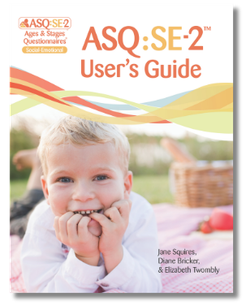
Go deeper:
For a summary of ASQ:SE-2 and ASQ-3 items related to behaviors associated with autism, see Table C.12 in the ASQ:SE-2 User’s Guide.
Is ASQ:SE-2 valid and reliable?
Yes. Validity, reliability, and utility studies were conducted on ASQ:SE-2 between 2009 and 2011 to accurately determine the psychometric properties of the screening instrument. Normative studies included 14,074 children, ages 1 month up to 72 months. The results support the ability of ASQ:SE-2 to discriminate between children with social-emotional delays and those who appear to be developing typically in social-emotional areas. (Join the ASQ website to unlock access to the ASQ:SE-2 technical appendix.)
How can ASQ:SE-2 help our program engage with families?
Screening with ASQ:SE-2 offers your program another platform for engaging with families. Through the social-emotional screening process, you can invite parents to share their unique, in-depth knowledge about their child and discuss any behaviors they may be worried about. Plus, you can keep families engaged between screenings by sharing the age-specific activities, handouts, and newsletters in ASQ:SE-2 Learning Activities and More.
With our parent handouts and tip sheets, you’ll have lots of ideas for keeping families involved in screening every step of the way. The more engaged families are in the screening process, the more likely they are to successfully support their child’s development, report concerns, and follow up on referrals.
Take the next step today:
- Watch a short video introduction to ASQ:SE-2
- View an informative slide deck
- Watch a webinar on using ASQ-3 and ASQ:SE-2 together
More posts like this

ASQ:SE-2: Your Key to Meeting New Guidelines for Social-Emotional Screening
November 28, 2024
9 Ways Home Visitors Can Support Infant Mental Health
October 8, 2024
Write a Comment
Your email address will not be published. Required fields are marked *
Post a Comment