
9 Strategies for Building Young Children’s Early Language Skills
June 5, 2026
In any early childhood learning environment, the day is filled with rich opportunities for nurturing young children’s early language skills and putting them on the path to later academic success. Excerpted and adapted from new and bestselling Brookes books, these 9 strategies can help you boost children’s developing language skills during instruction and free play.
Model language through sportscasting
Describe the actions of children like a sportscaster: “You’re putting one block on top of another.” “You’ve climbed so high!” “You’re eating your beans.” Sportscasting can also be used to describe what you’re doing. “I’m going to put on my coat so I’ll be warm outside, too.” “I think I’ll have some more water; I’m thirsty.” While it may seem silly at first, it’s an excellent way to build children’s vocabulary and model how to put words together in sentences while also connecting with them emotionally.
Explicitly teach phonological awareness skills
Teach young children to recognize sound patterns using familiar consonant-vowel-consonant words such as at, bat, cat, fat, hat, mat, pat, rat, sat. Prompt children to listen for and identify sounds at the beginning of a word or at the end of a word. Play with sounds using onset and rimes (e.g., /at/), changing the beginning sound to create new words. Introduce short vowel sounds, allowing ample time for multiple repeated exposures and practice opportunities before introducing more new information.
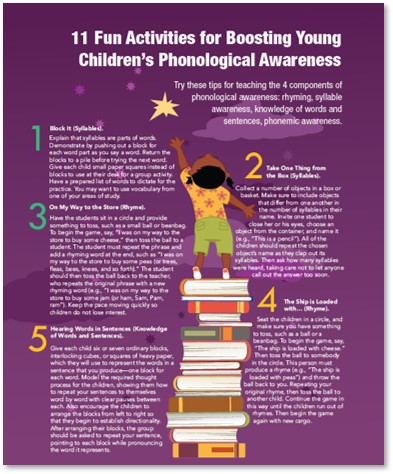
Play games with vocabulary practice
Think of games that give multiple opportunities to learn and use words, in multiple playful settings. For example, say, “I’ve made a treasure hunt of words around the room. Let’s see who can find them first. Then, we’ll have a chance to talk. We’ll work those words into our sentences!” These games are more effective when you focus your vocabulary units around fun, high-interest themes.
Ask open-ended questions
Posing questions to young children is a great way to build early language skills. Start with simpler questions when children are very young (e.g., “What color is that?”), and then as they get a little older, ask questions that go beyond quizzing and really engage thinking and curiosity:
- “Why do you think your friend is crying? How can we help him feel better?”
- “Why do you think it gets dark at night?”
- “What do we need for our tea party?”
- “Who did you play with at child care today? What did you do together?”
- “How do you think we can make this toy go?”
- “That looks like some sort of seed pod. Where did you find it? Do you think it came from a tree?”

GO DEEPER:
When kids ask questions of their own, keep the conversation going with these 10 tips for answering their questions well.
Use favorite stories and songs
Ask families to record favorite stories, rhymes, or songs for the whole class to learn together, or ask families or your local librarian for favorite books (storybooks or ones that label familiar objects). Remember that repetition of well-loved songs, stories, and rhymes is the very thing that makes them so good for language learning.
Try collaborative storytelling
Start by offering children basic storytelling elements, for example, PPP (person/people, place, and problem). You might start, for example, by saying, “There was a group of firefighters who got a call about a fire on a street. They went to the street (place) only to find that there weren’t any fire hydrants! (problem). What did they do after that?”
- You can then go around in a circle, asking each child to contribute a sentence or idea. Encourage children to complicate the story and search for solutions, for example by saying, “And then, this made the problem worse” or “And then, the character solved that problem by…”
- Also encourage children to discuss the consequences of actions. For example, say, “And that solution created a new problem…”
- Let children know that stories can be ongoing and can always be retold and revised.

GO DEEPER:
Watch this coffee chat on Promoting Language via Oral Storytelling, presented by Trina D. Spencer (co-author of Watch this coffee chat on Promoting Language via Oral Storytelling, presented by Trina D. Spencer (co-author of Assessment of Story Comprehension).
Encourage speaking in complete sentences
Provide multiple opportunities for children to use their language skills to describe, narrate, ask questions, and respond in complete sentences. Demonstrate how people change their voices and body language when asking a question or making a statement, and have children copy your model and role-play. Identify and use question words in oral language activities: who, what, when, how, why.
Strive for five turns
Children’s language skills are enriched and expanded when adults engage them in back-and-forth conversations that extend over multiple turns and encourage the child to play an active role. Dickinson & Morse use the phrase “strive for five” as a rule of thumb—that is, try to have a sequence of five back-and-forth exchanges with the child before the conversation ends.
Incorporate home languages
For children learning a different home language (including sign language), ask families to provide a list of common terms related to routines, and tips on pronunciation, if needed, so that you can incorporate them into your conversations during daily routines.

GO DEEPER:
Discover 5 practical ways to support language and early literacy skills in young dual language learners.
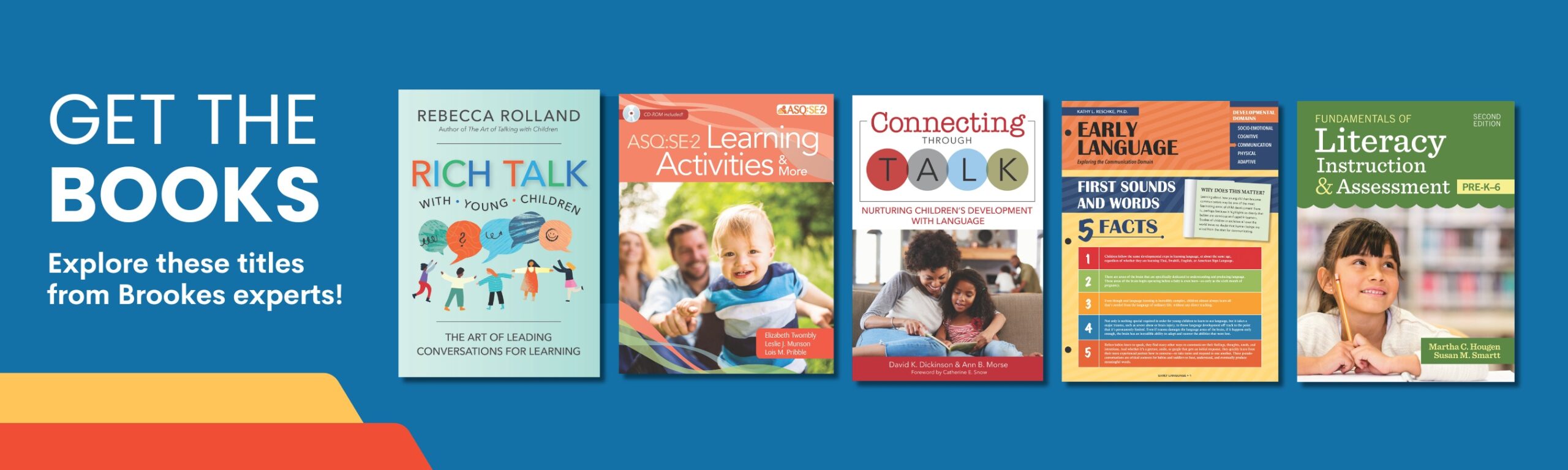
- Tips 1, 5, and 9 adapted from Early Language, part of the Quick Reference Guides for Early Childhood Best Practices series by Kathy L. Reschke
- Tips 2 and 7 adapted from Fundamentals of Literacy Instruction & Assessment, Pre-K–6, Second Edition, edited by Martha C. Hougen & Susan M. Smartt
- Tips 3 and 6 adapted from Rich Talk With Young Children by Rebecca Rolland
- Tip 4 adapted from ASQ®:SE-2 Learning Activities by Elizabeth Twombly, Leslie Munson, and Lois Pribble
- Tip 8 adapted from Connecting Through Talk by David K. Dickinson & Ann B. Morse
More posts like this
10 Tips for Answering Children’s Questions Well
February 26, 2026
11 Fun Animal Activities That Encourage Early Language & Literacy Skills
September 15, 2022
Write a Comment
Your email address will not be published. Required fields are marked *
Post a Comment