
9 Reasons Why Your School Needs a Crisis Team
May 12, 2026
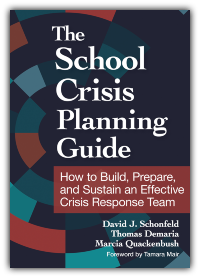 This article was adapted from The School Crisis Planning Guide by David Schonfeld, M.D., FAAP, Thomas Demaria, Ph.D., & Marcia Quackenbush, M.S., MFT.
If you’re a school leader working with limited resources, you might wonder, “Is it really necessary to put a crisis team in place? And is it worth it?” The answer to both questions is an unequivocal yes. It’s not a question of whether a crisis will occur in your school community—rather, it’s what the crisis will be and how well you will be prepared to respond.
The consequences of not having an effective team at the ready are substantial. Here are 9 things that can happen in a school that is not adequately prepared to cope with a crisis.
Administrator Burnout
Without an effective crisis team, too much responsibility is placed on individual administrators. Especially in major crises, one or two people trying to manage the response are quickly overwhelmed. They become exhausted and ineffective in implementing response strategies. It is virtually impossible to keep up with the necessary and ongoing everyday work of school administration while dealing with a significant crisis.
Staff Paralysis
Without clear guidance, staff do not know what to do when a crisis occurs. This increases confusion, frustration, and distress. Ultimately, your staff may end up doing little due to a sense of helplessness and feelings of frustration.
Increased Student Risk from Misinformed Strategies
Without clear guidance, educators may move forward with misinformed strategies. For example, a teacher might respond to the suicide of a student by thinking, “I’m not going to discuss suicide because it will give students ideas, and they might hurt themselves.” This is not a best practice, and it has the potential to be harmful and increase student risk.
Confusion in Students and Families
When staff is unclear about what steps should be taken, they are likely to deliver vague or conflicting messages to students. This causes confusion for students and their families. Confusion leads to lack of trust and lost confidence in leadership and increases fears about safety.
Sensitive support from a teacher can be a powerful protective factor for students and their families. See this article for 5 Ways to Provide Ongoing Support to Grieving Students and Families.
Lack of Documentation
When crisis response is not well organized, recordkeeping about the response is usually poor. Even when appropriate action has been taken, there may be no way to document this later for administrators, regulators, local or state government, or the greater community. This failure to document will limit the ability to obtain financial reimbursement for allowable expenses. There is also no way to evaluate what has been done for continuous improvement purposes.
Unintentional Bias
Without clear guidance and an understanding of current leading practices, people tend to focus on what they believe works well. Their own reference may not be the best choice for all students. For example, one school concerned about safety issues after a school shooting hired additional uniformed school safety officers to patrol the campus. However, because of recent local conflicts between police and communities of color, students of color actually felt more, rather than less, threatened.
Inefficiencies and Overlooked Needs
Without a clearly planned response, actions tend to be directed toward obvious areas of need. Important steps may be missed, while others are duplicated. For example, two people might be reaching out to provide information to mainstream press because reporters are showing up and asking questions. Meanwhile, no one is considering how students are communicating with each other about the incident on social media.
Highly Stressed Staff
In a crisis situation, it is difficult for staff to feel supported to pursue professional self-care. People may become physically ill from stress-related health conditions, develop mental health issues, or experience a worsening in preexisting mental health challenges. They may feel burned out or develop compassion fatigue. They may become less effective in their work and less satisfied with their careers. Over time, they may leave education altogether.
Poorer Outcomes for Students, Family, and Staff
In the absence of a coordinated response to a school crisis, students may increase risky behaviors. School climate may deteriorate, and school engagement may diminish. Families may feel frustrated and unacknowledged. And ultimately, school relationships with the community may worsen.
The work of an effective crisis team can make a world of difference for students, staff, schools, and communities. To safeguard your school against the outcomes outlined in this article, take the first steps toward establishing and sustaining an effective crisis team. The new guidebook The School Crisis Planning Guide has all the practical guidance you need to make it happen.
The School Crisis Planning Guide
How to Build, Prepare, and Sustain an Effective Crisis Response Team
By David Schonfeld, M.D., FAAP, Thomas Demaria, Ph.D., & Marcia Quackenbush, M.S., MFT
Developed by an author team with decades of experience—including David Schonfeld, the country’s go-to authority on responding to school crisis—this urgently needed book is every school leader’s ultimate guide to proactive preparation. Get critical information on the nuts and bolts of establishing and strengthening efficient crisis teams, plus best practices and strategies for responding to different types of school crisis.
More posts like this

5 Ways to Provide Ongoing Support to Grieving Students and Families
April 25, 2023
Author Q&A: David Schonfeld and Marcia Quackenbush on the new edition of The Grieving Student
March 2, 2021
Write a Comment
Your email address will not be published. Required fields are marked *
Post a Comment