
How to Help Students with Disabilities Self-Monitor Their Progress
October 5, 2026
 Depending on their strengths and needs and the nature of their learning goals, some students with disabilities may not independently acquire the skills they need to self-monitor their performance and track their progress. You can help by applying the six steps in this blog post, adapted from Jennifer Mahdavi’s book A Teacher’s Guide to Progress Monitoring.
Prerequisite: Build Awareness
If a behavior or skill cannot be named or recognized, it cannot be tracked or monitored. For example, if students don’t recognize that they constantly interrupt other speakers, they will not be able to evaluate how often they engage in that socially inappropriate behavior. Have students act out situations that clearly demonstrate interrupting behavior and compare these to ordinary conversation. Facilitating discussions about rude interruptions versus normal conversation will also help all students differentiate the two kinds of talking.
Step 1: Develop Social Validity
Social validity is the notion that the change to be undertaken is important to the learner, significant to the community, and acceptable to the interventionist. You can increase the social validity of the effort by working closely with a student to select their own behavior or skill to change. Rather than just trying to convince the student that they should work on a particular skill, ask the student what change they would like to make.
Goals have the greatest social validity to the individual (who must do the hard work of achieving them) when that individual has chosen those goals. And social validity may be the difference between forcing a learner “off the plank” or that person happily diving off the highest board.
Step 2: Develop Awareness of Variability in the Skill
Because some individuals with disabilities may be unfamiliar with the ideas of progress monitoring, graphing, or even thinking about how their performance varies from one day to the next, early lessons must focus on these concepts. If you’ve already been collecting data about your student’s progress, you may want to share that first.
Have a conversation with the student about their current level of performance and goals for the future. Encourage the student to discuss what they know about their performance by asking questions to help them self-monitor. The early stage of self-monitoring involves being able to answer the questions, “What do I do well?” and “What do I need to do better?”
Step 3: Use Explicit Instruction
Direct, explicit instruction with the “I-do, we-do, you-do” pattern (Archer & Hughes, 2011) is perfect for teaching students how to monitor their own behaviors. Here’s how to do it:
- Explain and model the process (“I-do”). For students with more limited communicative ability, self-evaluation may consist of comparing performance to a model and then indicating whether the two match. As you model the steps, explain each one to your student so they can follow your thinking as you develop your graph or fill in your chart.
- Distribute your selected self-monitoring tool to learners (“we-do”). This tool may be prefilled with relevant information to get the learner started more quickly. During this instructional stage, each learner should have a turn to interact with the tool, filling it in and describing the thinking behind doing so, pressing the correct button, or offering the correct picture icon. This is an opportunity to closely observe the student and quickly correct any errors.
- Let students practice self-monitoring under loose guidance (“you-do”). After each learner has performed self-monitoring under close guidance, gradually release them into this phase. Refrain from the impulse to jump in quickly to prompt students, but don’t allow learners to struggle for such a long time that they give up the attempt.
Step 4: Rate Progress Alongside the Student
During the early stages of self-monitoring, keep your own records of progress in parallel with the ones the learners keep. Each day that the charts are marked, compare your own with what the learner showed. This is an excellent way to build interrater reliability—that is, consistency in how different individuals rate or categorize the same behavior—and to check that the results obtained are an accurate reflection of performance.
Step 5: Collaboratively Evaluate Progress
Your interrater reliability check-in can be a supportive and celebratory time as well as a measure of accountability. Take a moment to talk about the change in ability demonstrated by the graph. You can ask the learner what they did to make the improvements recorded or what actions they may take to do better the next time. Always encourage the learner to take ownership of the work that has been done and that will be done in the future.
Clear, specific statements about what the graphs reveal, connecting the progress to the effort, help those with less experience understand how to engage with the process. Rather than just say, “I met my goal this week,” your student may say, “I met my goal this week, and I think it was because I paid attention to using that strategy we have been working on.”
Step 6: Fade Supports
One key to increasing self-determination in students with disabilities is to fade or remove supports when they’re no longer necessary. When we continue to provide scaffolding that learners don’t need, they are not forced to work more independently. In terms of self-monitoring, the supports we need to fade include specific teaching about how to self-monitor, side-by-side progress charting, and collaborative evaluation.
Following these six steps will help students with disabilities reflect on their work and self-monitor the progress they’re making in your classroom. For more guidance on the art and science of progress monitoring, read this Q&A with author Jennifer Mahdavi and add her book to your professional library!
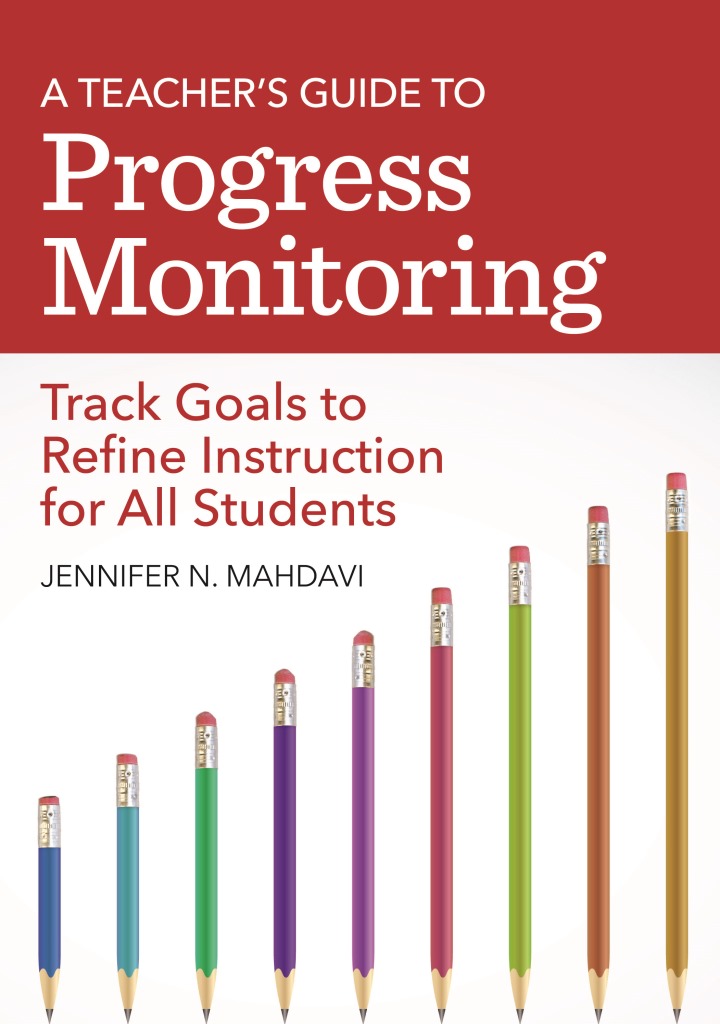 A Teacher’s Guide to Progress Monitoring
Track Goals to Refine Instruction for All Students
By Jennifer N. Mahdavi, Ph.D.
“Makes the process of ongoing assessment come alive . . . a must-have for teachers who want to ensure that all students make progress toward learning goals.”—Diane Haager, Professor Emeritus, California State University Los Angeles
“The comprehensive case studies provide the real-world link that readers need to see progress monitoring in action!”—Elizabeth Potts, Missouri Western State University
More posts like this
5 Myths and Truths about MTSS and Young Children with Disabilities
August 31, 2026
12 Academic Supports to Help All Students Succeed
October 9, 2025
Write a Comment
Your email address will not be published. Required fields are marked *
Post a Comment