
From Evidence-Based to Emmie-Based: The Science of Reading and Progress Monitoring
October 7, 2026
 Why should progress monitoring (PM) go hand-in-hand with your evidence-based reading instruction?
Brookes author Jennifer Mahdavi, the expert behind A Teacher’s Guide to Progress Monitoring, is with us today to connect progress monitoring with the Science of Reading. Dr. Mahdavi offers a vivid example of how PM can help teachers refine their instruction—and improve outcomes—for students who struggle with reading skills.
***
You’ve been well prepared to use Science of Reading (SOR) evidence-based practices. You can easily describe the difference between phonemic awareness and phonics and the importance of each one. You have first-hand experience with how well most of your students learn when you teach them with systematic, explicit instruction.
Yet it is January and first-grader Emmie, who has attended school regularly and worked diligently every day, is not experiencing the same growth in her reading skills as her peers. Her performance under your excellent SOR instruction does not make sense.
Science of any kind also requires assessment and evaluation of the effects of the treatment recommended to ensure its effectiveness. Science of Reading establishes what and how to teach literacy; progress monitoring helps you determine whether the SOR practices you are implementing are effective for Emmie.
Progress Monitoring: A Meaningful Element in the Science of Reading
SOR’s foundations rest on research from diverse fields like neuroscience, linguistics, psychology, and education. The converging findings from these disparate fields provide a strong evidence base for teachers to use structured, systematic, explicit instruction in foundational literacy skills (e.g., phonemic awareness, phonics, fluency, vocabulary, and comprehension) to support all learners.
Progress monitoring (PM) is a kind of formative assessment that helps us evaluate whether students are learning at a rate that will keep them at grade level. For Emmie, that means we can go beyond “she doesn’t seem to be making progress” to finding evidence of how much and how quickly she is learning. Critically, PM will help us determine when we need to change the instruction Emmie receives
The Science of Reading is also implicated in the identification of children who have dyslexia. As a language-based reading disability marked by difficulty with rapid naming, phonological processing, and fluent reading and spelling, dyslexia can be remediated with SOR evidence-based instruction. Progress monitoring is commonly recommended as a tool to screen for dyslexia and ensure that interventions are effective for individual students.
We don’t know if Emmie has dyslexia, but finding out is important.
Be a Scientist of Reading Instruction
You want Emmie and all of your students to leave first grade as proficient readers. That means that like any good scientist, you need to use research-validated teaching techniques in your classroom and also conduct tests to ensure that your “experiments” are proceeding according to plan.
Emmie and other children who struggle to master literacy skills are relying on you!
Your school district very likely has a preferred measure for progress monitoring in reading. Maybe you have been trained to use it, but never really understood how the juice was worth the squeeze. Seek out this PM package at your site. Let’s make that data live instead of relegating it to a shelf for use only 3 times a year.
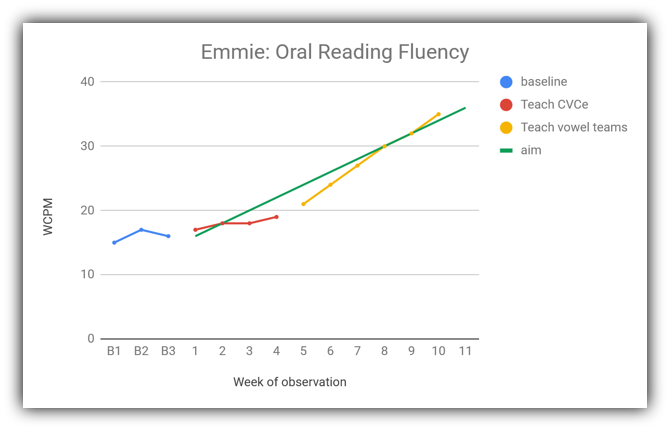
Each week, administer an oral reading fluency (ORF) measure to Emmie and keep a graph of the words read correctly per minute (WCPM). Repeated measurements of the WCPM score will show you whether your instruction is yielding the level of progress that will get Emmie back to grade level expectations. Three weeks in a row of flat or slow growth mean that your instructional strategy needs to change; a reliably rising line confirms that your approach is working.
You start by establishing a baseline by administering an ORF measure 3 times and chart that on your graph (see the blue line on the sample graph below). This shows that Emmie’s baseline fluency is clearly below expectations for a mid-year first grader.
 Knowing that Emmie’s oral reading fluency places her in an at-risk or literacy failure category is not enough. These data are like the check-engine light in a car. When that light comes on, we know something is wrong with the car, but we need to plug the car into a computer to diagnose the issue that needs to be repaired. Similarly, our PM data light up the fact that we have a problem, but not what that problem is. We need to dig into Emmie’s performance to find the barriers to reading growth. Diagnostic assessment helps us understand whether the child has foundational phonemic awareness or phonics skills and where the gaps in knowledge are.
Emmie’s PM graph for oral reading fluency documents our first intervention, teaching her to read and spell the CVCe pattern (the red line on the graph). Her weekly progress over 3 weeks with this intervention is too slow. That check-engine light is shining like a beacon!
Because the PM graph does not tell you why Emmie’s progress is so slow, you administer your favorite phonics screener. You’re asking a different assessment question: not “Is Emmie making progress?” but “What does she need to advance?” Your screener shows you that Emmie can read about 85% of the CVCe words she is presented with, but that her grasp on vowel teams like ai and ea is tenuous. You move Emmie into a group working on the vowel teams and continue weekly PM. Soon you see a steep increase in Emmie’s WCPM (the yellow line) and you begin to notice her confidence and comprehension also growing.
Eureka! SOR told you what to teach, and PM told you whether that instruction was working. When Emmie’s progress lagged, you made a data-based change to your instruction. When her progress accelerated, your graph let you know to continue your effective practices for now.
That is data-based decision making, and progress monitoring supplied the data.
Science Never Rests
You and Emmie (and her parents) are so excited to see her mastering the foundations of reading. As her WCPM edges closer to grade level, you continue your systematic progress monitoring and explicit phonics instruction. It is important that Emmie continues to make adequate progress toward reading proficiency. Scientists do not stop their research when they solve one problem; they and we continue to dig for better methods and better answers.
If you have not implemented progress monitoring before, it can feel overwhelming to put the procedure in practice. Just as we do for our students, we need to lean on our own assets as the foundation for acquiring new skills. If you feel confident about SOR techniques, you are well prepared to select and adapt evidence-based literacy instruction.
The Next Step
Your next step is to collect and use data to evaluate the impact of SOR on students like Emmie. My book, A Teacher’s Guide to Progress Monitoring, can support you as you develop your PM skills and add them to your teaching laboratory. It’s a practical, teacher-friendly guide, and you can read some of the reviews and get your own copy at the link below.
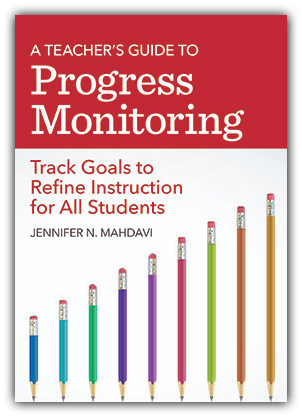
A Teacher’s Guide to Progress Monitoring
Track Goals to Refine Instruction for All Students
By Jennifer N. Mahdavi, Ph.D.
Ideal for educators in K-12 classrooms—but also applicable to preschool and transition programs—this practical guide is your key to using PM to comply with federal mandates, refine your teaching, and help every learner achieve success.
"Makes the process of ongoing assessment come alive . . . a must-have for teachers who want to ensure that all students make progress toward learning goals.”—Diane Haager, Professor Emeritus, California State University Los Angeles
"An excellent resource and training tool for special educators…provides sound reasoning and pragmatic suggestions.”—Melinda Susan, Director, South County Consortium, Adjunct Faculty, Sonoma State University
“The comprehensive case studies provide the real-world link that readers need to see progress monitoring in action!"—Elizabeth Potts, Missouri Western State University
More posts like this
The Power of Progress Monitoring: Q&A with Jennifer Mahdavi
July 27, 2026
Teacher Tips: High- and Low-Tech Ways to Manage Your Progress Monitoring Data
April 18, 2023
Write a Comment
Your email address will not be published. Required fields are marked *
Post a Comment