
Top 3 Myths About DAP and SOR—Debunked!
November 3, 2026
 Early educators sometimes see developmentally appropriate practice (DAP) and the science of reading (SOR) as two incompatible approaches that can’t coexist in the same classroom. But with some careful planning, DAP and SOR can actually blend into powerful and playful early literacy experiences that set young children up to be successful readers.
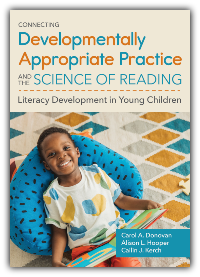
The new book Connecting Developmentally Appropriate Practice and the Science of Reading shows early childhood programs how to combine the best of each approach to support early literacy learning. In this post, excerpted and adapted from the book, we’ll take a look at the persistent myths around DAP and SOR—and uncover the truth behind those common misconceptions.
Myth #1: DAP Ignores Systematic Instruction, SOR Ignores the Individual Child

One common misconception is that DAP recommends educators use only child-led instruction, such as free play, meaning children may not be exposed to literacy concepts unless they choose to explore them on their own. This is not true. Instead, DAP recognizes the need for intentional teaching that includes a thoughtful balance of child-led and teacher-led activities.
On the other side, some people equate SOR with only teacher-led whole- and small-group activities. Instead, SOR also advocates for a balance of activities, especially for young learners, specifically emphasizing engagement and meaningful application of skills. This can often occur through play, when children use and expand their literacy skills through reading and writing to advance their play and act out common scenarios.
Myth #2: SOR Doesn’t Value Creativity, DAP Doesn’t Value Rigor

Without a thorough understanding of SOR, it may be easy to conclude that this approach prioritizes conformity over creativity. Instead, SOR recognizes that creative expression is essential for language development and can be integrated with explicit skill building, such as a child composing a story using target vocabulary words. Teachers also exercise their creativity as they read aloud to children, using different voices, pausing, and asking questions to engage children in the reading experience.
In contrast, some people believe that DAP does not value rigor. However, DAP encourages teachers to challenge their students in ways that are responsive to their development. A rigorous early childhood classroom is one where children’s learning is supported and intentionally scaffolded by knowledgeable educators. Again, deep knowledge of SOR and how literacy develops can help early childhood educators implement DAP more effectively.
Myth #3: SOR Only Cares About Decoding, DAP Only Cares About Play

While explicit and systematic phonics instruction is a cornerstone of SOR in the primary grades, SOR also emphasizes the importance of other language and literacy skills, like oral language and comprehension. Nor does DAP advocate play as the only teaching practice to use.
Instead, DAP encourages teachers to draw on their understanding of each child to determine a unique set of scaffolding, supports, and strategies tailored to that child’s needs. DAP incorporates direct skills instruction as children show readiness and interest. To categorize SOR as only about decoding and DAP as only about play misconstrues the priorities of both approaches and obscures the ways they can work together in early childhood classrooms.
Classroom Example
The following example highlights how educators might come to a new understanding of how to align research-based practices with their commitment to developmentally appropriate activities:
A local child care director recently attended training about SOR and brought the information back to her staff. At a weekly faculty meeting, she encouraged teachers to seek out their own professional development about SOR and begin incorporating these practices in their classrooms.
However, the director isn’t specific about what she expects.
The toddler teachers in the building meet in the hallway after the meeting. Megan, one of the toddler lead teachers, is very concerned about this shift toward implementing SOR. It does not sound developmentally appropriate for the children in her class. She imagines them sitting on the carpet while she shows them alphabet flashcards. This does not align with her commitment to play-based learning and DAP.
Luckily, Ellen, another teacher on the toddler team, recently completed a graduate course focused on SOR. Ellen shares that play-based learning can and should still happen in early childhood classrooms aligned with SOR. She provides examples of practices that align with SOR in early childhood, such as singing rhyming songs, discussing the first sounds in children’s names, utilizing alphabet toys and manipulatives, and reading picture books aloud.
Megan feels reassured by this, since these are all practices she supports and implements. She realizes that implementing SOR in a toddler classroom does not mean teaching primary-grade phonics instruction, and she looks forward to learning more about
SOR now that she knows it is not in opposition to play-based learning.
Combining SOR and DAP: Your First Step
DAP and SOR are more aligned than different, and they can complement each other well if programs know how to use them together. Your first step: get the book behind this blog post, a cost-effective resource for teacher professional development!
Connecting Developmentally Appropriate Practice and the Science of Reading
Literacy Development in Young Children
By Carol A. Donovan, Ph.D., Alison L. Hooper, Ph.D., & Cailin J. Kerch, Ph.D.
Focused on birth–pre-K with an emphasis on ages 2–5, this groundbreaking resource helps teachers combine the best of DAP and SOR into powerful, playful, and developmentally appropriate early literacy experiences. The book is packed with explicit tips, guidance, and recommended practices for supporting early literacy learning—plus 20+ authentic video clips that show these practices in action.
More posts like this

How Dialogic Reading Helps Young Children Think and Learn
August 20, 2026
12 Best-Practice Tips for Building Young Children’s Writing Skills
September 28, 2023
Write a Comment
Your email address will not be published. Required fields are marked *
Post a Comment