
8 Ideas for Helping Young Children Develop Key Social Skills
October 16, 2026
Whether at home or in an early learning setting, every day is packed with opportunities to strengthen the social skills and emotional development of young children.
Try these helpful ideas and activities for encouraging the social and emotional skills of older toddlers and preschoolers. If you’re an early childhood professional, share these tips with the families you work with so they can try them at home!
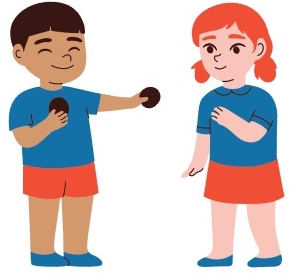
Skill: Taking Turns
A good time to emphasize sharing is when children are working on individual projects that involve shared materials. For example, when working with playdough, provide enough materials for every child to have one tool (e g , a rolling pin, a cookie cutter, a plastic knife). Invite the children to exchange the tools. You will find that secure children are often generous and naturally share with others, and you can quietly compliment children on their sharing behaviors. Use language such as “When finished,” “Wait,” “Next,” “Done,” “Your turn,” “Their turn,” and “Share ”
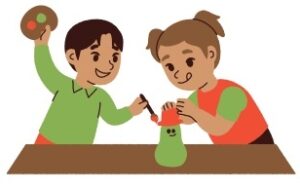
Skill: Peer Play
Start encouraging children to play cooperatively for a short time. If the children are building while engaged in parallel play beside each other, ask them if they can build a tower together by taking turns adding blocks to the tower. Encourage one child to offer pieces to the other child to put on the tower. Use words such as “Cooperating,” “Sharing,” “Working together,” “Playing together,” and “Building together.” Encourage joint play in other areas, and when reading stories, point out when characters are working and playing together.
 Skill: Naming Emotions
Helping a child express their feelings using words is an important developmental goal When a child seems to be angry, sad, disappointed, lonely, or happy, gently name these feelings for them using a tone that matches the feeling. You can say phrases like, “You’re so sad,” “You’re really mad,” or “You are so happy!” While reading, discuss the feelings of the characters with the child. And throughout your day, point out and label the feelings of others in your family or center by saying, “Look, Stacy found her blanket She is so happy!” or similar statements
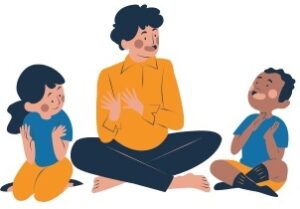
Skill: Recounting Details
Being able to remember and talk about past events contributes to the child’s ability to understand social and other events in their life. Encourage the child to recount details of a recent event involving other people. Ask the child to tell you what happened during the event. Use language such as “Before,” “Just happened,” “After,” “Then,” and “Next.” When reading, stop to discuss what just happened in the book and encourage the child to think about what might come next.
 Skill: Pretend Play
Provide a few dress-up props, such as hats, scarves, or ties. Gather the items for playing restaurant, with a pot, pan, wooden spoon, and some unbreakable plates, cups, and spoons. Be creative! Make time to join the child and help them use their imagination. Pretend play can also be used to “act out” difficult situations that worry a child. Help them talk about feelings and think about solutions by using their imagination: “Uh-oh, Mousy is sad because Daddy is leaving for a trip. What can Mousy do?”
 Skill: Working Through Challenges
Little challenges help a child learn to work hard and keep trying (persist). They will need encouragement when they are getting frustrated: “You can do it.” “You’re almost there—keep trying.” Your confidence in the child’s skills will help build their confidence. Skills such as learning to ride a tricycle (or bicycle with training wheels), climbing to the top of a structure, or drawing a simple shape offer opportunities for them to learn how to persist.
 Skill: Making Friends
Include planned activities to promote caring connections and foster relationships between children. For example, ask a classroom helper to use a board with photos of children on magnets to note who is present or absent in the classroom. The child can move the photos of children who are absent to a graphic (e.g., heart, hug) as you say “we hope they feel better soon.” Other connection activities can be as simple as helping children learn their classmates’ names (e.g., have a child pass out materials to peers, teach peers to respond by saying thank you and the child’s name) or structuring interactions between children by adding a greeter as a classroom job.
Skill: Caring and Nurturing
When the world feels scary, nurturing dolls and stuffed animals is a good way for children to refocus their feelings and practice caring behavior. Set up toy cribs where children can put their “babies” to bed, water tables where kids can bathe their dolls, and places where the babies can be fed with old bottles, sippy cups, and spoons. Help children create caregiving scenarios and praise children for their TLC. (Be sure to include kids of all genders in this activity—every child can benefit from practicing their caring skills.)

- Ideas 1-4: Adapted from Beautiful Beginnings, Second Edition, by Helen H. Raikes, Darcy D. Lenz, & Katlyn M. Hoggatt
- Ideas 5-6: Adapted from ASQ®:SE-2 Learning Activities & More, by Elizabeth Twombly, Leslie J. Munson, & Lois M. Pribble
- Idea 7: Adapted from the book Unpacking the Infant–Toddler Pyramid Model, by Amy Hunter, Mary Louise Hemmeter, Kathryn M. Bigelow, & Neal M. Horen
- Idea 8: Little Kids, Big Worries by Alice Sterling Honig
More posts like this

20+ Tips for Creating a Classroom that Nurtures Social-Emotional Development
September 8, 2026
How to Boost Learning with Breathe–Move–Learn: Sample Lesson 1
June 16, 2026
Write a Comment
Your email address will not be published. Required fields are marked *
Post a Comment