
Debunking 4 Common Myths About Family-Centered Practice
March 24, 2026
F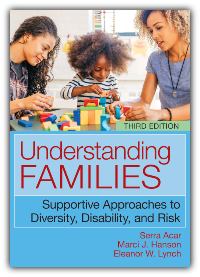 amily-centered practice has become a hallmark of high-quality early childhood programs and services. But for family-centered services to truly become the norm in programs, both providers and policymakers need a full understanding of what the term means—and doesn’t mean.
Adapted from the new third edition of Understanding Families by Serra Acar, Marci J. Hanson, and Eleanor W. Lynch, this post clears up a few persistent myths and misunderstandings around the family-centered model of practice.
Myth 1: The Role of Professionals Is Diminishing
Truth: Professionals are vital to effective intervention. Their training, knowledge, skills, and experience complement the family’s knowledge of their own child, their preferences and priorities as a family, and their commitment to care over a lifetime.
Without equal respect for what each person brings to the relationship, there can be no partnership. This is one of the guiding principles of family-centered practice.
By the time families seek professionals for assistance and support because of concerns about their children, they want more than a friendly face. They want knowledge and assistance in putting that knowledge into the family’s context—their values, beliefs, strengths, and needs. Any interpretation of family-centered practice that excludes professional knowledge, experience, and expertise is faulty, as is any interpretation that leaves the child out of the picture.
Myth 2: Only Family Concerns Are Important
Truth: An extension of the myth that professionals are devalued in a family-centered model of practice is the myth that service providers should address only those issues that the family identifies as important. For example, if the family is only concerned that the child’s behavior is a serious problem, the professional should not mention her concerns that the child may also have hearing loss.
The truth is, this perspective runs counter to family-centered practice. If families and professionals are to develop real partnerships, professionals cannot withhold information that they consider to be important.
Professionals may consider the family’s concerns first and work on one issue at a time, making the family’s concerns the first priority. But they should also voice their own concerns and request the family’s permission to proceed. Most important, information should be given to families in capacity-building ways that support their self-confidence and ability to parent and facilitate their learning without threatening their knowledge and ability (Bruder, 2000; Trivette et al., 2010).
Myth 3: Formal Supports Are Bad
Truth: Another misunderstanding is that formal supports such as counseling, classes, or workshops on behavior support or agency-organized inclusive playgroups are inherently bad and should be avoided. Some people prefer formal supports to informal opportunities to learn, receive help, or socialize. One of the guiding principles of family-centered practice is the individualization of services to meet the preferences of diverse families.
Considerable attention has been paid in recent years to informal support—the marshaling of resources that are part of a family’s daily life, such as other family members, friends, neighbors, colleagues at work, and faith communities. Effective supports, however, may also be direct. They may include structured opportunities for families to participate in learning about resources, their child’s disability, and strategies for working more effectively with the child, professionals, and agencies. Although informal supports are important and often make us feel good, they’re rarely sufficient to address all the issues surrounding a child with a disability or serious behavioral problems.
Myth 4: Only Professionals Must Change
Truth: The belief that well-trained professionals could singlehandedly make family-centered practice a reality is a myth. For family-centered practice to be achieved, professionals, families, agencies, and policymakers may all have to change.
Family members must have the resources and desire to participate in new ways. Customizing services requires that families put forth additional effort to make selections that they consider best for their child and family. It also requires that professionals work to ensure that customized services are integrated. And agencies and policymakers must change if family-centered support is to become the norm—they must shift from the current emphasis on offering a menu of services to offering integrated programs in early intervention.
***
Each of these four myths can be overcome. At its simplest level, family-centered practice is providing supports and services that the family desires and values to enhance child and family outcomes within a respectful partnership between families and professionals. If your practice is guided by this definition, myths and misunderstandings are likely to fade away.
For more on family-centered practice and providing the best services to diverse families, get the new book behind today’s blog post!
Understanding Families
Supportive Approaches to Diversity, Disability, and Risk, Third Edition
By Serra Acar, Ph.D., Marci J. Hanson, Ph.D., & Eleanor W. Lynch, Ph.D.
With the third edition of this bestselling text, pre- and inservice practitioners will develop the critical skills and knowledge they need to understand and support diverse families of children birth to 5. Enhanced with timely updates reflecting changes in the research and the field!
References
Bruder, M. B. (2000). Family-centered early intervention: Clarifying our values for the new millennium. Topics in Early Childhood Special Education, 20, 105–115.
Trivette, C. M., Dunst, C. J., & Hamby, D. W. (2010). Influences of family-systems intervention practices on parent-child interactions and child development. Topics in Early Childhood Special Education, 30(1), 3–19.
More posts like this

9 Strategies That Promote Family-Centered Practices
February 10, 2026
7 Tips for Writing Functional Goals for IFSPs and IEPs
March 28, 2024
Write a Comment
Your email address will not be published. Required fields are marked *
Post a Comment