
Reading Comprehension: Classroom-Ready Tips for Teacher Think-Alouds
April 14, 2026
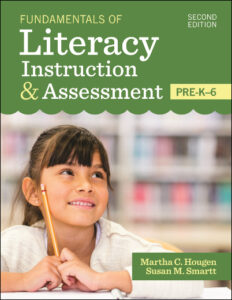 *This article has been adapted from the chapter “Comprehension Instruction: Grades K–3” by Darcy Dycha and Holly Tate Rocha, in Fundamentals of Literacy Instruction & Assessment, Pre-K–6, Second Edition, edited by Martha C. Hougen & Susan M. Smartt, with invited contributors.
One effective way to enhance reading comprehension instruction is the teacher think-aloud: sharing what’s happening inside your own head as you make sense of the text you’re reading. Think-alouds make abstract cognitive processes more concrete for young students, and they give kids a model for using comprehension strategies successfully.
Teacher think-alouds should be planned in advance so they’re clear and concise. This article offers tips and specific examples for using teacher think-alouds to boost six core comprehension strategies in Grades K-3:
- Activating background knowledge/making connections
- Creating mental images
- Making inferences
- Questioning
- Retelling/summarizing
- Monitoring, clarifying, and fixing up

Activating Background Knowledge/Making Connections
Good readers make connections from the text to their background knowledge to help them comprehend. Here’s how to use think-alouds to help support this skill.
What to do:
- Keep your think-aloud authentic. Really connect the text to something in your life.
- Keep your explanation brief so you don’t take away from the text.
- For expository text, model how you can use background knowledge to understand a new concept.
- When thinking aloud, use the stem, “This part in the story reminds me of…” Follow up with, “My connection helps me understand…”
What it might sound like:
“Jason is sad that his mom and dad are leaving. That reminds me of a time when my parents left me with a babysitter. My tummy felt all funny, and I couldn’t stop crying. I really didn’t want my parents to leave me. My connection helps me understand how Jason is feeling right now. He’s really upset that his parents are leaving.”

Creating Mental Images
Good readers create a mental movie of the text as they are reading. Here’s how to use think-alouds to help support this skill.
What to do:
- Demonstrate how you use all five senses to create mental images of the text. Make your thinking specific and descriptive.
- Help students clearly understand the images in your head.
- Reinforce that good readers also use pictures provided in the text to help them create mental images.
- Explain how your mental images help you understand the text.
What it might sound like:
“Wow, I can clearly picture in my head the storm the author is describing. I can see the bright light flash across the dark sky, and I can hear the loud crrraaaack when the lightning hit the tree. I can imagine the burnt smell from the top of the tree wafting down to the kids huddled below and what it must have felt like to have the leaves of the broken branch scratch against their arms. My mental image helps me understand how scary it must have been to be under that tree during the storm!”
 Making Inferences
Good readers use their background knowledge along with clues in the text to make inferences. Here’s how to use think-alouds to help support this skill.
What to do:
- Plan how you’ll share the inferences you make while reading. You will want to identify the clues in the text as well as the background knowledge you used to make the inference.
- Demonstrate the difference between information that is directly stated in the text and information that must be inferred.
What it might sound like:
“I know that Rosa is sad because the author told us. The author wrote, ‘Rosa is sad.’ I didn’t have to make an inference.”
“I’m inferring that Rosa is feeling happy now. The author didn’t say that Rosa is happy, but the author told us that Rosa smiled a big smile and clapped her hands together when she saw the surprise. I know from my background knowledge that people smile when they are happy and that they usually feel happy when they get a surprise.”
 Questioning
Good readers engage with the questions that come to mind while reading. Here’s how to use think-alouds to help support this skill.
What to do:
- Post question stems (e.g., who, what) in the classroom to help students be aware of questions that come to mind while reading. During your think-aloud, model referring to the question stems.
- Model how you continue to reflect on your questions as you read looking for answers. Expand your think-aloud by noting where you find answers to your questions. Model that occasionally good questions go unanswered, and that’s okay too.
- Use the stem, “This part in the text makes me wonder…” Follow up with, “My questions help keep me interested in the text and I remember better too.”
What it might sound like:
“Hmm. I’m wondering something. Why do octopuses need three hearts? Can they still live if something happens to one of their hearts? Let me read on to see if I can find the answers to my questions.”
“Here is the answer to my first question right here in the text. The three hearts each do a different job.”
 Retelling/Summarizing
Good readers can identify information that is most important in the text, pull together key information, and explain it in their own words. Here’s how to use think-alouds to help support this skill.
What to do:
- For both fiction and nonfiction, graphic organizers are helpful in teaching this strategy. Be consistent in the type of organizer you use.
- For fiction, ensure that the story elements are included on the organizer. For young students, organizers may include a place to record character, setting, beginning, middle, and end. As students get comfortable with these concepts, introduce problem, solution, events, and theme. Teaching story elements explicitly is crucial for comprehension.
- For nonfiction text, help students distinguish between essential and nonessential information. Use stems such as, “This is mostly about…” to help identify the main idea.
What it might sound like:
“This story is mostly about Bear so far. I think he is the main character.”
“The problem is that Bear won’t share his toys with anyone, so he doesn’t have any friends. I’m inferring that that’s why he feels lonely.”
“Bear has figured out the solution to his problem. He knows now that if he shares with others, they will want to play with him. Now he is having fun with the other animals in the forest.”
 Monitoring, Clarifying, and Fixing Up
Good readers know when their understanding breaks down and then do something to repair their misunderstanding. Here’s how to use think-alouds to help support this skill.
What to do:
- Plan in advance how you will model a lack of understanding while reading.
- Then, ensure that you think out loud what your confusion is and what your plan is for fixing it.
What it might sound like:
“I’m confused by this part. It says that Sherri slipped on her shirt and quickly went out the door. But if she slipped on her shirt, doesn’t that mean that she fell down? Let me reread this part again and I’ll try to create a mental image of what she is doing.”
“Now I understand. I inferred that the word slipped meant that she fell down. But in this case, the word slipped means that she quickly put her shirt on and then went out the door. Now, I can create a mental image of Sherri getting dressed quickly so she wouldn’t be late for school.”
KEEP LEARNING:
Read 6 Strategies That Improve Reading Comprehension in Young Learners for tips on choosing books that will help you teach these six core strategies to young learners.
For more on reading comprehension instruction, interventions, and assessment, see the book behind this article: the comprehensive text Fundamentals of Literacy Instruction & Assessment, Pre-K–6, Second Edition.
Fundamentals of Literacy Instruction & Assessment, Pre-K–6, Second Edition
Edited by Martha C. Hougen, Ph.D., & Susan M. Smartt, Ph.D., with invited contributors
“This treasure is a must read for all pre-service teachers! Hougen and Smartt bring together the science of reading and effective instruction and assessment from the perspective of reading scientists and educators.”—Marcia Henry, Ph.D., author of Unlocking Literacy.
More posts like this
6 Strategies That Improve Reading Comprehension in Young Learners
February 11, 2025
5 Ideas for Enhancing Comprehension During Small-Group Instruction
October 10, 2024
Write a Comment
Your email address will not be published. Required fields are marked *
Post a Comment