
6 Steps to Designing Inclusive, Differentiated, and Collaborative Lessons
June 11, 2026
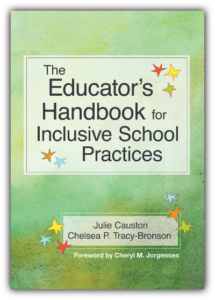 How can teachers create inclusive, differentiated, and collaborative lessons that meet the needs of all learners in their diverse classroom? Excerpted and adapted from The Educator’s Handbook for Inclusive School Practices by Julie Causton & Chelsea P. Tracy-Bronson, here are 6 actions for designing purposeful lessons that are accessible and useable for all learners from day one!

Write Positive Student Profiles
The first step in designing inclusive lessons is to think about the learners in your class. Identify three students who represent an academic, behavior, and social range of the learners in your class. Be sure to think about students with a disability and/or English language learners.
Write a positive student profile for each of these students that includes likes, dislikes, strengths, and information about their communication, behavior, and academic and subject-specific performance. The purpose of this step is to proactively think about the range of learners in your class and design with their strengths and needs in mind.
 Consider Content and Standards
The second step is to know the content standards and concepts you intend to teach. Examine the standards that apply in your state. Design your plans around these standards. Think specifically about what you want students to know and be able to do as a result of the lesson.
 Think Divergently
The third step requires you to think divergently about the structures and strategies you might use to deliver the lesson and collect assessment data. Think about how you will teach content and engage students in the lesson. Brainstorm what products students might create to demonstrate their understanding. Reflect on which types of products will allow your range of learners to demonstrate their newly learned knowledge. Be sure that all students will be challenged.
You might try creating a list of ideas or a concept web. Your purpose here is to think divergently about how the lesson might be structured and brainstorm in a way that makes sense to your educational team.
 Develop a Learning Plan
The fourth step is to develop a learning plan. Here are some things to do:
- Create whole-class objectives. Think about the essential standards that every student will learn and be able to do.
- Think about what most students will learn and be expected to be able to do.
- Consider enrichment learning experiences for a few students.
- Create any student-specific objectives to incorporate IEP goals. This ensures the lesson is designed with a range of learners in mind.
- Develop a plan to collect preassessment data prior to your teaching. Use this to inform your planning.
- Design the learning sequence for the lesson, based on your district’s curriculum resources, the subject area, and the previous background of your team members.
- Think about individual accommodations, modifications, and supplemental aids and supports that specific students need to be successful. Build these into the lesson from the onset.
- Create an agenda and decide how you will explain the objectives to students.
- Design purposefully engaging and fun lesson hooks and closures. (TIP SHEET: Download 8 Great Ideas for Lesson Closures.)
 Conduct Assessment
It is crucial to monitor students’ learning progress toward their goals and objectives. Here are some key things to do:
- Collect multimodal formative assessments to gain a clear idea of student understanding at various points across the lesson or curriculum unit.
- Gather evidence of student learning. Ask, “What information will I collect throughout or on an ongoing basis?”
- Analyze this evidence to determine what instructional supports, accommodations, and modifications you need to provide.
- Meet students’ needs by designing additional learning experiences based on this data.
- Continue to collect and analyze evidence. Then make changes to your instructional plans.
- Plan summative assessment. Ask, “What am I assessing? How am I assessing it? What criteria am I using? Am I using a rubric or tool to assess the work?” Analyze this summative assessment data alongside the preassessment and formative assessment.
 Debrief and Reflect
Inclusive educators engage in ongoing critical reflection about the natural teaching and learning cycle. This reflection aids in enhancing student learning outcomes. Think about student participation and learning, as well as your planning, preparation, and teaching.
Think about when, where, and how adults will debrief and evaluate the outcomes of the lesson and unit. You might ask the following questions:
- What did the class learn from this as a whole, and what did individual students learn?
- What did students have success with, and what did they have difficulty with?
- What would we do differently next time?
- What did we learn about co-teaching together?
- What am I proud of?
- What might I adjust for the next lesson?
- Was the lesson fun, and how engaged were students?
Analyze the instructional strategies, materials, planned supplemental supports, and the learning environment as a whole. You might ask these questions:
- Were the accommodations, modifications, or supplemental aids and services appropriate for the target students? What might I change to better meet students’ needs
- What strategies did I use to encourage independence and investment in the learning process?
- Was the learning environment conducive to learning? Did it meet individual students’ needs? What needs to be changed?
- How did the learning environment promote students’ sense of belonging and
- community?
- How did learners apply their new knowledge?
- How did students engage in metacognitive thinking, self-evaluation, or self-correction to improve and develop deep understanding?
You should also directly include the students in the debriefing process, asking them questions about where they were successful, what they had difficulty with, and what they would suggest for next time.
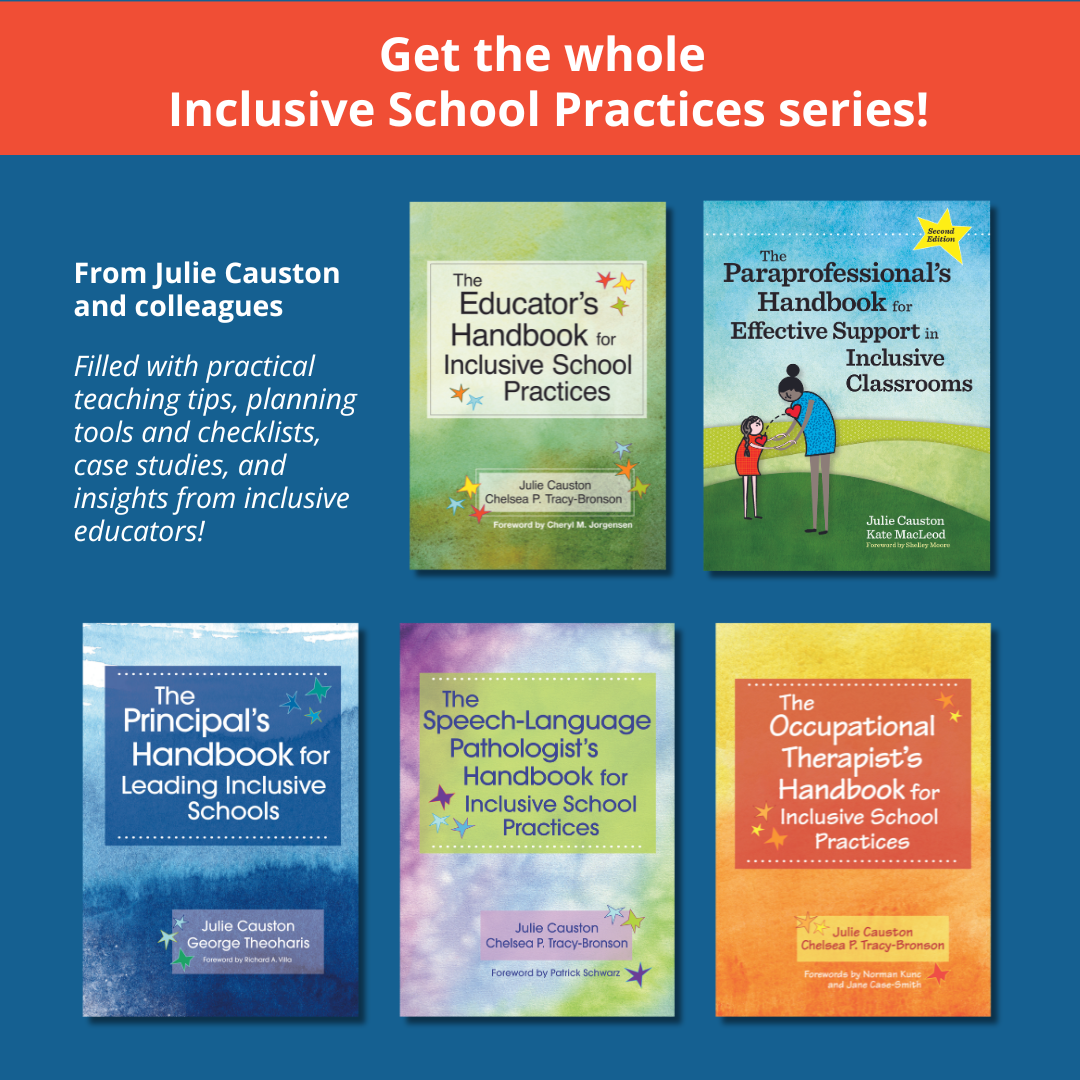 Explore the Whole Series: Great for staff training, these friendly inclusion guides are filled with role-specific guidance on creating engaging, exciting, and joyful classrooms that support social and academic success for all. See the series here >>
Interested in Bulk Orders? We offer special pricing on these books for school districts and large organizations. Contact us here >>
More posts like this
9 Academic Support Strategies for Inclusive Classrooms
November 21, 2025
12 Academic Supports to Help All Students Succeed
October 9, 2025
Write a Comment
Your email address will not be published. Required fields are marked *
Post a Comment