
9 Mindset Shifts for Every Inclusive Educator
October 27, 2026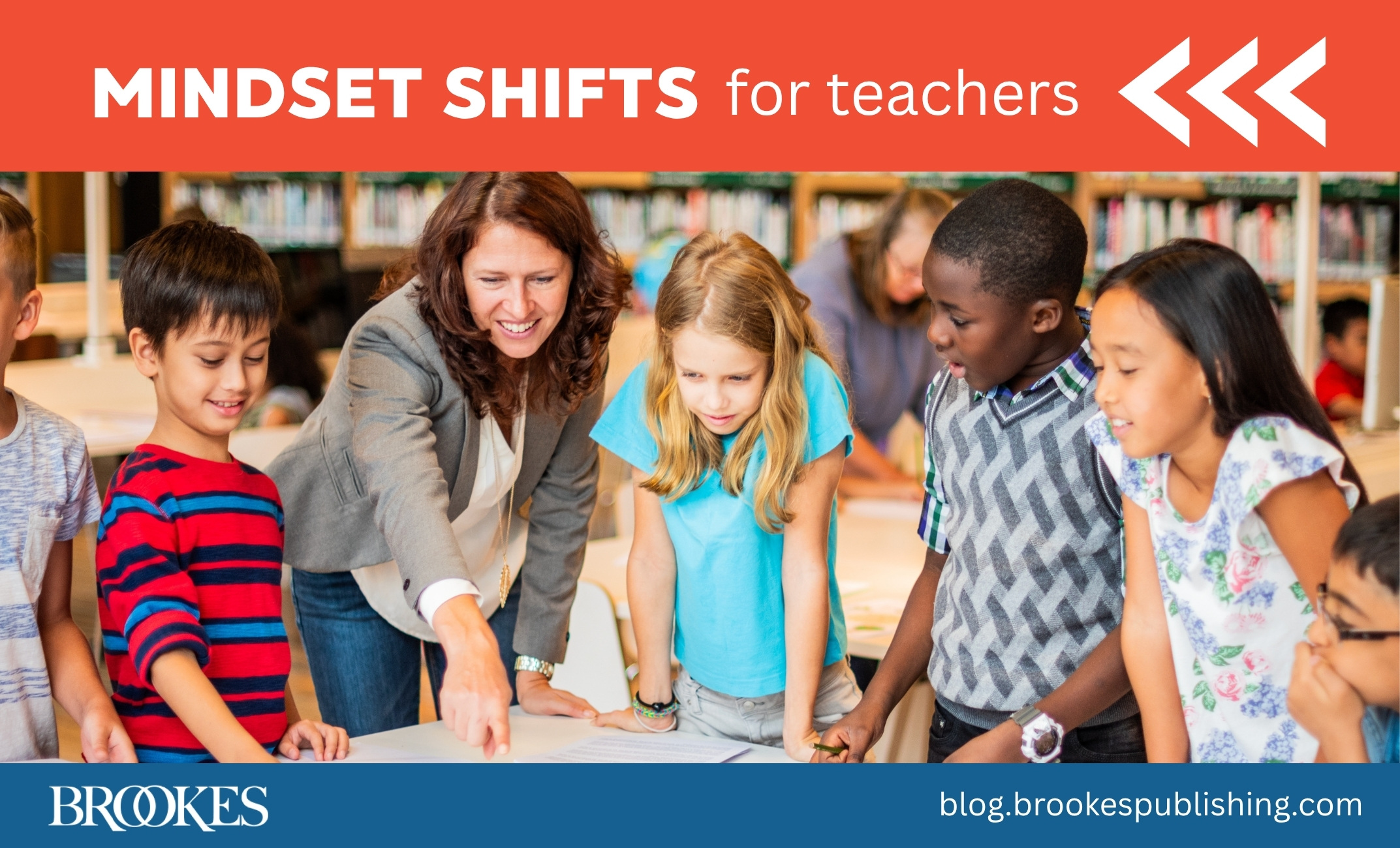
Maybe you’re already 9 for 9 on these. But maybe there’s a mindset shift on this list that can help you do more good for your students this year.
Take a minute with these important changes in perspective for inclusive educators, adapted from popular Brookes books from inclusion experts!
Avoid assumptions about competence
Ask yourself if you’re making predictions or assumptions about a student based solely on the way that student looks, moves, or communicates. Always make the least dangerous assumption—that is, presume competence—even if you feel uncertain about a student’s abilities at first.
Dismantle your “deficit lens”
Focus on the positive qualities and support needs of each learner. Flip the language that’s often used to describe students. For example, instead of thinking of John as a “nonreader” who “can’t follow directions,” you might say “John enjoys listening to stories read by others and needs systematic reading instruction. He’s an independent thinker who will need some support to follow directions that are essential for daily life.”

For more in-depth guidance on how to switch to a strengths-based mindset, pick up the book Reimagining Special Education by inclusion experts Jenna Rufo and Julie Causton!
Take a variability perspective
Think of a traditional learning goal derived from a science learning standard: Learners will read an article and write a one-page report describing the rotational relationships of the sun, Earth, and moon. This approach will work for some learners, but it creates barriers for those who lack background knowledge or have difficulty with English vocabulary, reading, or writing.
Take a variability perspective by developing clear, flexible, rigorous learning goals: After reading a hyperlinked article, viewing visual and video modeling, and engaging in peer brainstorming, learners will explain the rotational relationships of the sun, Earth, and moon. Instead of only a written report, provide choices for learners to show that they’ve met the learning goal: verbal descriptions, a poster or digital model, etc. To support diverse learners, offer scaffolds such as peer brainstorming to help with planning, a multilingual vocabulary chart, and a project guide divided into procedural steps.
Change up corrective feedback
If you have students who need support during activities, providing a stream of corrective feedback can feel overwhelming and discouraging. Consider deciding with a student in advance how errors will be corrected. You can schedule regular times for monitoring and feedback. For example, you could say to the student, “I’m going to check in with you every 15 minutes,” or “I’m going to check in with you at the end of each activity and give you feedback.” Reducing the volume of corrective feedback may help your students be more receptive to it.
Challenge biases around behavior
Be careful not to interpret a student’s behavior through your own preconceived notions. For example, if you notice that a student on the autism spectrum who uses AAC to communicate has been enjoying flipping through books, don’t assume she’s just stimming or getting sensory stimulation. Assume she may be communicating an interest in reading, and ask the SLP to add a “want to read” request on your student’s AAC device.
Distinguish between a can’t and a won’t
Avoid the assumption that defiant actions are always willful. Many behaviors actually stem from “downstairs brain” reactions—activation of the student’s fight, flight, or freeze survival reflex. Because many behaviors you see at school, especially from traumatized students, result from a can’t instead of a won’t, neither consequences nor incentives will be effective. In fact, they could make things worse. Look beyond punitive responses, since students need safety and support to regulate their stress response systems.

As more and more students struggle with the effects of trauma, it’s more important than ever to build trauma-sensitive learning environments.
See how Ms. Jen Alexander’s resources can help!
Rethink “attention seeking”
How many times do we label students as “attention-seeking” as if it’s a bad thing? When students seek connection and help when they are needed, that’s a sign of health and should be encouraged. Any person’s genuine need for attention is legitimate, and it’s not wrong to give students attention or provide help when they are dysregulated and need assistance. Consider building in times throughout the day when students receive unconditional one-to-one time with an adult when they need it.
Reframe special interests as learning tools
When a student has intense interests and passions, it can be tempting to think of them as distractions. But when special interests are integrated into learning materials, daily routines, and lessons, the learner’s feelings and preferences are honored and the teacher’s need to move beyond the interest is also satisfied. For instance, if you have a student who loves trains, they might be asked to write a story about riding on a caboose, research different railroads, or do an independent research project on ground transportation in America. A learner who adores pop stars could read magazine stories about them, write them letters, estimate ticket sales and projected revenue for concert tours, and replace the lyrics of favorite songs with content that they need to know for science or social studies tests.

Get a whole collection of practical, ready-to-use ideas for using student fascinations to promote learning! Pick up Just Give Him the Whale! by Paula Kluth.
Think like a parent
Remember that every student is someone’s child. If you feel frustrated with a student, imagine that you are someone who deeply loves that person. Try to imagine what it would be like if you had watched the child grow and learn from infancy onward. How would you react from that perspective? How might you react if it were your son, daughter, niece, or nephew? If you react from a position of love and acceptance, you’re much more likely to respond with kindness and humanity than with punishment and control.
Whether you’re a new teacher or a seasoned educator, these mindset shifts will help you support the academic and social success of every student this school year. For more practical guidance from our experts, add the books from today’s post to your teaching toolbox!
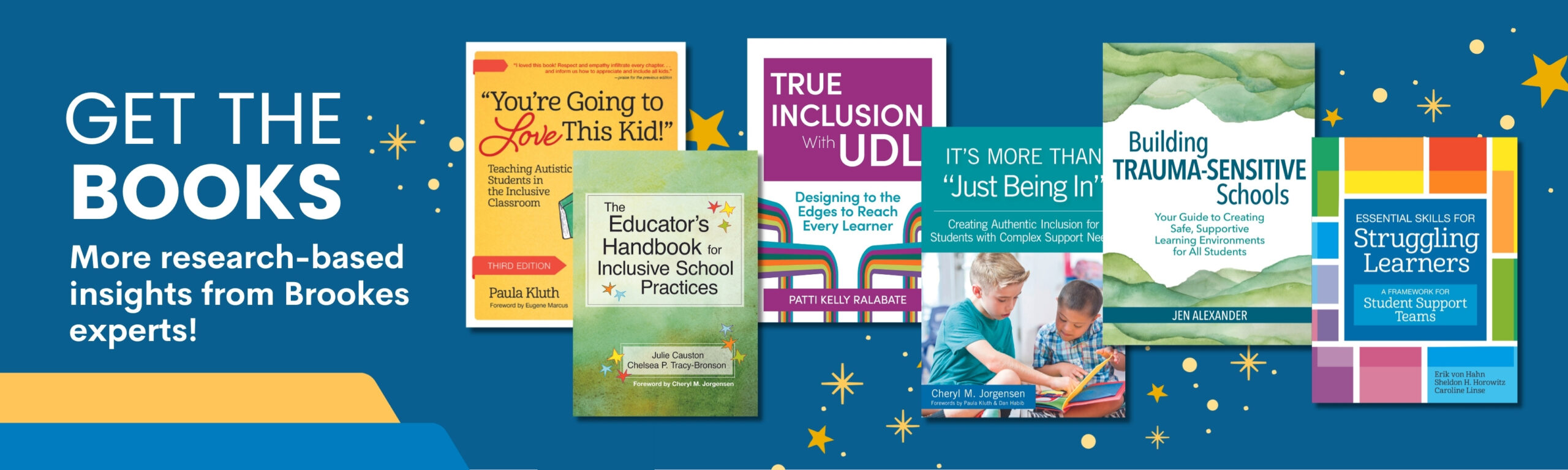
- Tips 1, 2, and 5 adapted from It’s More Than “Just Being In” by Cheryl M. Jorgensen
- Tip 3 adapted from True Inclusion With UDL by Patti Kelly Ralabate
- Tips 6 and 7 adapted from Building Trauma-Sensitive Schools by Jen Alexander
- Tip 4 adapted from Essential Skills for Struggling Learners by Erik von Hahn, Sheldon H. Horowitz, & Caroline Linse
- Tip 8 adapted from You’re Going to Love This Kid! by Paula Kluth
- Tip 9 adapted from The Educator’s Handbook for Inclusive School Practices by Julie Causton & Chelsea P. Tracy-Bronson
More posts like this

5 Reasons to Get Your Students Unstuck and On Target!
July 28, 2026
6 Steps to Designing Inclusive, Differentiated, and Collaborative Lessons
June 11, 2026
Write a Comment
Your email address will not be published. Required fields are marked *
Post a Comment